
Anthropic Skills vs Diamond Mind AI: The Future of AI Workflows and Business Systems

Updated: 3 hours ago
AI workflows need both task instructions and business context. Anthropic’s Agent Skills and Diamond Mind AI’s business-system approach offer two useful lenses for discussing that design problem.
Agent Skills package instructions and resources for an agent. Diamond Mind AI is being developed around connecting business context with structured workflows and human review. It is in private testing; public signup is not currently open. This article compares approaches, not proven feature parity or commercial performance.
1. What Are Anthropic Skills?
Anthropic describes Agent Skills as folders of instructions, scripts, and resources that an agent can discover and load for a task. A folder can include:
Instructions or standard operating procedures (SOPs)
Code scripts or API connectors
Reference files, templates, or datasets
When a relevant Skill is selected, its instructions and supporting resources can help guide the task. Completion still depends on the agent, tools, inputs, and review process.
Progressive disclosure loads relevant instructions and resources as needed. It is a context-management approach, not a guarantee of security; Skills can introduce risks through instructions and code.
Illustrative example: a consulting team could organize proposal instructions, reference material, and a review checklist in a Skill. A person would still need to check the resulting proposal for accuracy and suitability.
Read more on Anthropic’s official site.
2. What Is Diamond Mind AI?
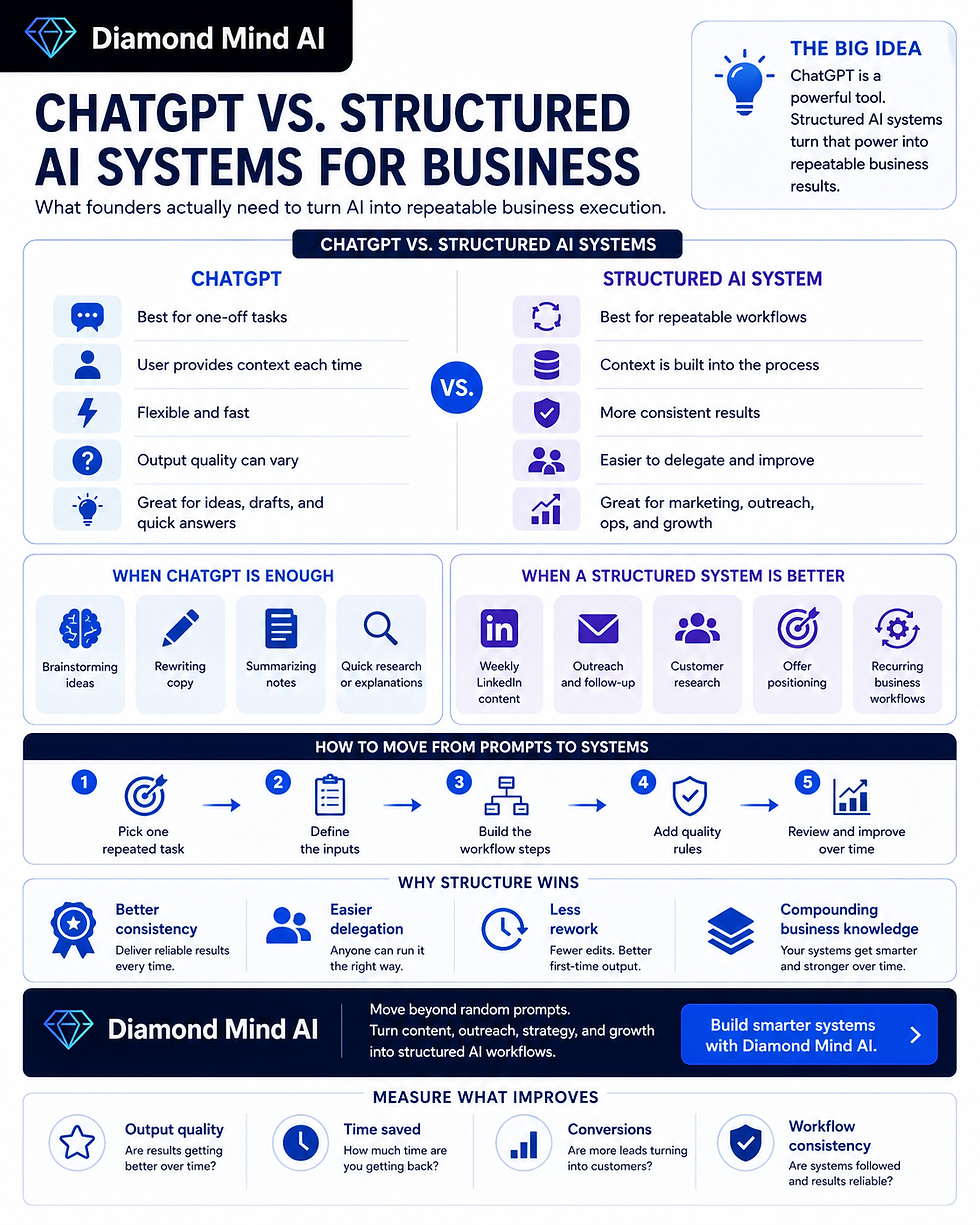
Diamond Mind AI’s intended focus is the business-system layer: connecting context, strategy, workflows, and review across repeated work.
A business workflow can be described from its broad function through stages, processes, and reusable instructions. This is an illustrative framework, not a current feature inventory.
For example:
A marketing workflow could organize audience context, an outreach brief, draft messages, and review criteria. This is an illustrative process, not a claim of live functionality or lead-generation results.
This article makes no commitment to n8n, Zapier, or other integrations, launch timing, or autonomous execution.
Explore the Diamond Mind AI approach here.
3. The Cookbook vs Kitchen Analogy
Analogy | Anthropic Skills | Diamond Mind AI design direction |
The Setup | You already have a robot chef (Claude) and teach it your recipes | A framework for designing the business process |
Focus | Package task instructions and resources for an agent | Connect context, workflows, and human review |
User Type | People and teams building agent workflows | Founders, consultants, and operators |
Ecosystem | Agent Skills is an open standard | No cross-model compatibility claim made here |
Execution boundary | Depends on the agent and its available tools | No cross-app execution claim made here |

In short: Anthropic makes the robot smarter. Diamond Mind AI makes you the architect.
4. Which Model Creates More Value?
Both solve real problems, but at different levels.
Factor | Anthropic Skills | Diamond Mind AI design direction |
Core Goal | Provide reusable task instructions | Connect context and repeatable business workflows |
Accessibility | Check current official availability and requirements | Private testing; public signup not currently open |
Integration | Open standard; implementation depends on the tool | No integration or launch commitment made here |
Audience | People and teams working with agents | Founders, SMBs, consultants, and operators |
What to evaluate | Task fit, permissions, reliability, and review | Workflow fit, verified capabilities, and review |
Neither approach establishes greater commercial value by itself. That requires evidence from the specific workflow, available capabilities, costs, and results.
5. The Coming Convergence
The following is a hypothetical workflow architecture, not a Diamond Mind AI roadmap or an available integration.
Illustrative use case, not a product commitment:
Define a campaign brief with business context and approved reference material.
Use an available AI tool to draft content.
Review and approve the content.
Use separately configured publishing and record-keeping tools where appropriate.
Such a workflow connects human intent, AI assistance, and business execution only when each step, permission, and tool connection has been deliberately configured and tested.
6. Choosing the Right Approach
Your Goal | Design question |
Automate repetitive internal processes | Can an available agent follow the procedure safely and reliably? |
Create repeatable business systems | What context, steps, and review criteria are needed? |
Need AI to follow precise company SOPs | Can the SOP be documented and tested as reusable instructions? |
Reuse a workflow across a team | How will you document ownership, handoffs, and review? |
Connect a workflow to automation tools | Which connections and permissions are available and verified? |
A possible design practice is to document the workflow logic first, then assess whether an available agent format or tool can support it. This is not a claim that Diamond Mind AI exports to Skills or other agents.
7. The Bigger Picture
AI’s next frontier is not just automation. It is alignment. The real value comes from systems that connect people, tools, and models into one predictable flow.
Agent Skills address reusable agent instructions. Diamond Mind AI’s intended business-system approach emphasizes the context, workflow, and review around the work.
That is why it is built not as another AI tool, but as a business operating system for the AI era.
8. Final Thoughts
The useful lesson is to connect instructions with a clear business process. Define the context, steps, permissions, and review criteria before relying on automation.
If you want predictable workflows, faster execution, and AI systems that grow with your business, start here.
Explore Diamond Mind AI Learn about the approach to connecting business context, structured workflows, and human review. Public signup is not currently open.
Author Bio
Written by Amir Allen Razi, Founder of Diamond Mind AI and Head of Marketing and Business Development at Zero Impact Energy, Amir helps founders and teams turn AI from a collection of tools into structured business systems. His work connects clean energy, automation, and AI strategy to create clarity, scalability, and predictable growth in the new era of intelligent operations.


Comments