
Diamond Mind AI vs ChatGPT for Business: Which Is Better for Founders, Operators, and Teams?

Updated: Oct 8
ChatGPT is a general-purpose AI assistant used for writing, research, brainstorming, analysis, coding, and everyday productivity. Diamond Mind AI is being developed around a structured business-system approach for founders, operators, consultants, marketers, and business builders. Its design direction connects business context with repeatable workflows and human review. Diamond Mind AI is in private testing; public signup is not currently open.
Short answer
Use ChatGPT when you want a flexible AI assistant for broad tasks.
Consider the Diamond Mind AI approach when exploring how business context, guided workflows, and reusable systems could connect strategy to execution. This is design intent, not a claim of current public availability.

Diamond Mind AI design direction and ChatGPT: comparison framework
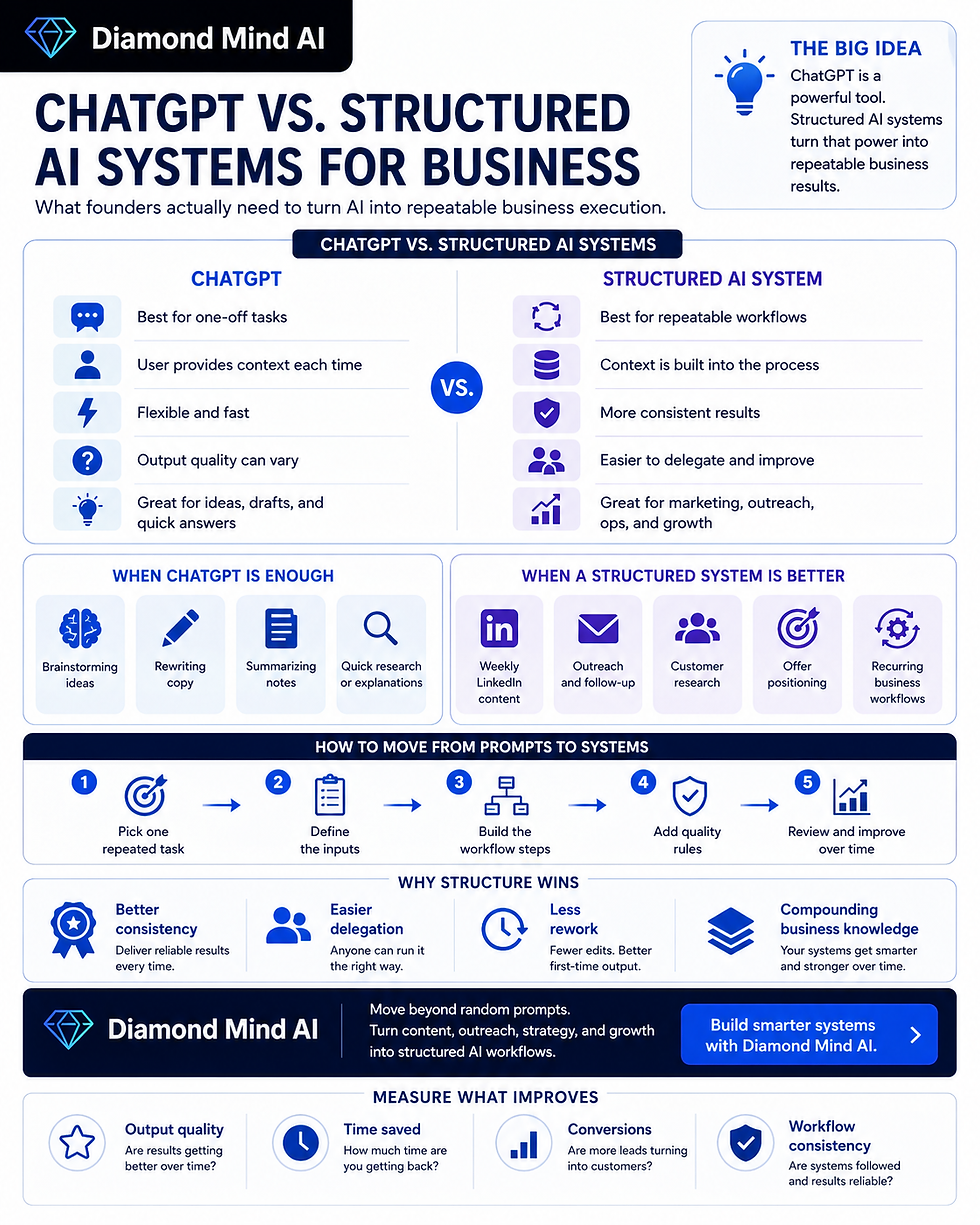
Category | ChatGPT | Diamond Mind AI design direction |
Best for | General AI assistance, writing, research, brainstorming, analysis, coding, and productivity | Structured business execution, content workflows, campaign building, messaging, and growth systems |
Starting point | Chat, or reusable project context | Context-first workflow design; current public access closed |
Business context | Depends on what the user provides in the prompt or workspace | Built around your business context from the start |
Workflow structure | Flexible, but user-directed | Structured systems built for specific business outcomes |
LinkedIn content | Can help if prompted well | Illustrative campaign-planning use case; no live offer here |
Repeatability | Depends on prompts, saved chats, projects, or custom setup | Designed around reusable workflows and business systems |
Best user | Anyone who wants a flexible AI assistant | Founders, operators, consultants, marketers, and teams who want AI to guide execution |
Main limitation | Can become scattered without clear prompts and process | Private testing; public signup not currently open |
Evaluation question | Does it support your tasks and process? | Does the intended approach fit your workflow needs? |
What is ChatGPT for business?
ChatGPT is one of the most widely used AI assistants for business productivity. Teams use it to draft content, summarize information, analyze data, brainstorm strategy, write emails, prepare meetings, create documentation, and speed up knowledge work.
For many companies, ChatGPT is a strong productivity layer. It can help a founder think through positioning, help a marketer draft campaign ideas, help a consultant structure a proposal, or help an operator turn rough notes into a cleaner plan.
The strength of ChatGPT is flexibility. It can help with almost anything.
A one-off chat without a reusable context source can create extra setup work. ChatGPT Projects can keep related chats, files, and instructions together, subject to settings.
That is where many founders and operators get stuck.
They do not need another blank box. They need a system.
What is Diamond Mind AI?
Diamond Mind AI is built for people who want to use AI as a structured business execution layer, not just a general chatbot.
The design direction starts with business context: the offer, audience, tone, goals, positioning, and desired outcomes. That context should inform the workflow and its review criteria.
A LinkedIn campaign is an illustrative application of this design direction, not an offer of a live personalized two-week campaign.
In simple terms:
ChatGPT gives you an AI assistant.
Diamond Mind AI’s intended direction is a structured business-system layer.
Why business users outgrow blank-chat AI
Blank-chat AI is powerful, but it often creates three problems for business users.
1. The output depends too much on prompting skill
ChatGPT can produce excellent work, but only if the user gives it the right context. Most business users do not have a repeatable prompting process. They ask one question, get one answer, rewrite the prompt, try again, and eventually get something useful.
That works, but it is inefficient.
The issue is whether the user or team has established reusable context and a clear process.
Diamond Mind AI’s design direction puts business context and workflow structure at the center of the experience.
2. Content can sound polished but miss the strategy
AI can write a clean LinkedIn post, landing page, or email. But polished content is not always useful content.
A post can sound impressive and still fail because it does not match the audience, offer, stage of awareness, or business goal. A landing page can sound professional and still lack a clear reason to buy.
For founders and operators, the goal is not just better writing. The goal is sharper execution.
The aim is to connect content back to business context and make strategic review part of the process.
3. Work does not always compound
A business owner might use ChatGPT to create a post today, rewrite a sales message tomorrow, brainstorm an offer next week, and plan a campaign later.
Each individual output may be useful. But if the work is not connected, the business does not build a reusable system.
Diamond Mind AI is designed to make the work compound. The more clearly the business context is defined, the easier it becomes to create repeatable workflows, messaging, campaigns, and decisions.
When ChatGPT is the better choice
ChatGPT is the better choice when you need broad flexibility.
Use ChatGPT if you want help with:
Research
Brainstorming
Writing and rewriting
Summarizing information
Coding help
Data analysis
Meeting preparation
General productivity
Open-ended problem solving
Creative exploration
ChatGPT is especially useful for teams that already have strong internal processes. If your company already has clear positioning, documented workflows, saved prompts, trained users, and organized business context, ChatGPT can fit very well into that system.
In other words, ChatGPT works best when the user or company already knows how to direct it.
When a structured business-system approach may fit
A structured business-system approach may fit when the challenge is organizing repeated work, context, and review.
Areas to consider include:
Founder-led content
LinkedIn campaign strategy
Business messaging
Offer positioning
Repeatable workflows
Strategic execution
AI-assisted marketing systems
Content planning
Operator workflows
Business growth systems
The intended Diamond Mind AI audience includes founders, consultants, coaches, agencies, operators, and marketers who want to organize repeated business work.
The goal is not to replace every ChatGPT use case. The goal is to make AI more useful for business execution.
The key difference: assistant vs operating system
The easiest way to understand the difference is this:
ChatGPT is an assistant.
Diamond Mind AI is a system.
An assistant helps when you ask good questions. A system guides the process before you ask.
That difference matters.
A business does not grow from random prompts. It grows from clear positioning, consistent messaging, repeatable workflows, and better decisions. AI becomes much more valuable when it is connected to that structure.
This is why many founders eventually need more than a prompt library or a general AI chat. They need a way to turn context into execution.
Illustrative example: planning a LinkedIn campaign
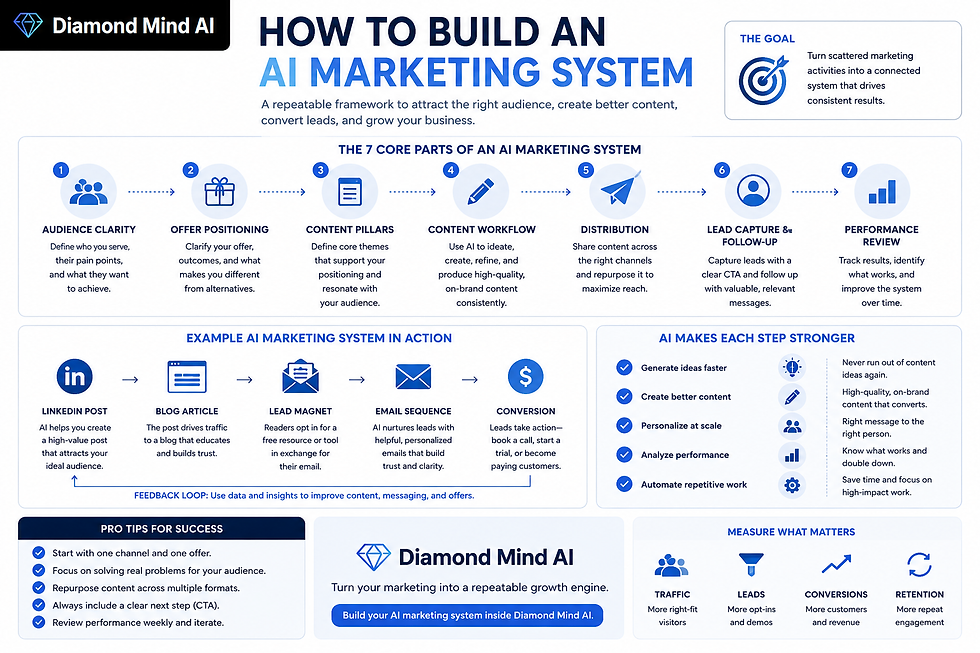
A founder can use ChatGPT to build a LinkedIn campaign by writing a strong prompt.
They might include their business description, offer, audience, goals, tone, content pillars, and examples of posts they like. Then they might ask ChatGPT to create a two-week content calendar.
That can work.
But the founder has to know what context to provide, how to structure the request, how to evaluate the output, and how to turn the content into a campaign.
A structured business-system approach starts by defining those inputs and checks explicitly.
In this example, business context informs the campaign brief, drafting steps, and review criteria. This is an illustrative workflow, not a demonstration of a live Diamond Mind AI feature.
That is useful for founders and operators who want AI to guide execution, not just generate content.
Diamond Mind AI vs ChatGPT vs prompt libraries
Some users try to solve the blank-chat problem with prompt libraries. Prompt libraries can be useful because they give users starting points.
But prompt libraries still have limits. They usually provide static prompts, not a living system. The user still has to choose the right prompt, add the right context, adapt the output, and connect the work across campaigns and workflows.
ChatGPT gives you a flexible assistant.
Prompt libraries give you reusable instructions.
Diamond Mind AI’s design direction connects business context with structured workflows and review.
Diamond Mind AI vs AI automation tools
AI automation tools are useful when you want to connect apps, trigger actions, and automate repetitive tasks. They can move data, send alerts, update records, generate drafts, or trigger workflows across platforms.
That is valuable, but it is not the same as a business thinking system.
Automation tools are often focused on task movement. Diamond Mind AI is focused on business context, messaging, strategy, and execution.
Use automation tools when you already know the workflow and want to automate it.
Use the Diamond Mind AI design approach as a framework for thinking through the workflow, message, campaign, or strategy.
Is Diamond Mind AI better than ChatGPT?
Not universally.
ChatGPT can support broad, flexible AI assistance.
Diamond Mind AI’s intended focus is structured business workflows. A current performance ranking would require testing and verified product availability.
A strong way to think about it is:
Use ChatGPT when you want an open-ended assistant.
Look for a structured business system when you need defined workflows and review criteria.
These approaches can be complementary.
An assistant can support research, analysis, or brainstorming within a structured workflow. That does not establish an integration or available Diamond Mind AI feature.
Decision framework: which one should you choose?
Choose ChatGPT if:
You want a flexible AI assistant
You enjoy creating your own prompts
You need broad support across many tasks
You already have strong internal workflows
You want one general AI tool for many use cases
Consider a structured business-system approach if:
You want structured business workflows
You need help turning strategy into execution
You want context captured deliberately
You want reusable systems instead of random prompts
You are focused on content, messaging, growth, and business clarity
You want to plan a campaign around a clear brief
Consider combining approaches if:
You need broad research and productivity support
You want a repeatable process around that work
You want to connect content, strategy, and review
Why structured AI systems matter
Generative AI is becoming a major productivity layer for business. McKinsey estimates that generative AI could add trillions of dollars in annual economic value across industries, and Nielsen Norman Group found significant productivity gains from AI tools in realistic business tasks.
But productivity does not come from access to AI alone. It comes from using AI with the right context, process, and workflow.
That is the core reason Diamond Mind AI exists.
The future of AI for business is not just better prompts. It is better systems.
Bottom line
ChatGPT is an excellent general-purpose AI assistant. It is powerful, flexible, and useful across a wide range of business tasks.
Diamond Mind AI is built for a more specific need: turning scattered AI use into structured business execution.
For founders, operators, consultants, marketers, and business builders, the real question is not whether ChatGPT is useful. It is.
The better question is:
How will you connect AI assistance with the context, process, and review your business needs?
Use ChatGPT when you need broad AI flexibility.
Explore the Diamond Mind AI approach if that business-system direction is relevant to your work. Public signup is not currently open.
FAQ
Is Diamond Mind AI the same as ChatGPT?
No. ChatGPT is a general-purpose AI assistant. Diamond Mind AI is being developed around a structured business-system approach that connects business context, workflows, and review.
Is Diamond Mind AI better than ChatGPT for business?
There is no verified overall winner. Compare the workflow, context, review needs, and available capabilities for the task you actually need to complete.
Can I use Diamond Mind AI and ChatGPT together?
A general-purpose assistant can be part of a structured business workflow. This article does not establish a live Diamond Mind AI integration or public access.
Who is Diamond Mind AI best for?
Diamond Mind AI’s intended audience includes founders, operators, consultants, marketers, agencies, coaches, and professionals seeking a more structured approach to business work.
What is the main difference between Diamond Mind AI and ChatGPT?
This article contrasts general-purpose AI assistance with Diamond Mind AI’s intended business-system approach. ChatGPT can also support reusable project context; the distinction is not simply blank chat versus memory.
Does Diamond Mind AI help with LinkedIn content?
LinkedIn campaign planning is an illustrative use case discussed here. This article does not offer a live personalized two-week campaign.
Is ChatGPT enough for business use?
ChatGPT can be enough for business users who already know how to prompt well and have strong internal systems. Users who need guided structure, reusable workflows, and business-specific execution may benefit from Diamond Mind AI.
What is an AI operating system for founders?
An AI operating system for founders is a structured layer that helps turn context, strategy, workflows, and execution into repeatable AI-powered systems. Instead of using AI randomly, founders use guided workflows to move from thinking to action.

Comments