
ChatGPT vs. Structured AI Systems for Business: What Founders Actually Need

Updated: Oct 8
ChatGPT changed how people work.
It made AI accessible to founders, marketers, consultants, operators, and small business owners without requiring technical training.
That matters.
Many people now use ChatGPT to write posts, summarize notes, brainstorm campaigns, draft emails, research ideas, and make decisions faster. OpenAI reported in January 2026 that over a quarter of U.S. workers use ChatGPT for work, and usage is especially high among workers with postgraduate degrees.
But there is a difference between using ChatGPT and building an AI-powered business.
That difference is structure.
ChatGPT is a powerful tool.
A structured AI system is a repeatable business workflow.
For founders and small teams, that distinction matters because the goal is not just to get answers faster.
The goal is to get better, more consistent business outcomes.
ChatGPT Is a Tool, Not a Business System
ChatGPT can help with many individual tasks.
It can draft a LinkedIn post.
It can summarize meeting notes.
It can write a cold email.
It can brainstorm a landing page.
It can explain a complex topic.
It can help build a spreadsheet or workflow.
ChatGPT can use project files, instructions, and related chats as context, subject to settings. Your business still needs to define its inputs, review rules, and next steps.
That is where most users struggle.
They open ChatGPT, paste context, generate something useful, close the tab, and repeat the same process again later.
This creates one-off productivity.
It does not create a reusable business system.
A system requires:
defined inputs
repeatable steps
consistent context
quality rules
clear outputs
performance feedback
improvement over time
ChatGPT can operate inside that system.
But the system does not appear automatically just because the tool is powerful.
Why Random Prompting Breaks Down
Random prompting feels productive at first.
You ask for something.
You get an answer.
The answer is usually better than starting from a blank page.
But over time, random prompting creates hidden problems.
The output changes too much
One day, the writing sounds sharp.
The next day, it sounds generic.
One day, the sales email is direct.
The next day, it feels bloated.
One day, the strategy memo is useful.
The next day, it misses the point.
That inconsistency happens because the system behind the prompt is weak or missing.
The user has to re-explain everything
The user has to keep explaining:
who the business serves
what the offer is
what the tone should be
what the CTA is
what the current goal is
what should be avoided
That becomes exhausting.
The tool saves time, but the setup still creates friction.
The work is hard to delegate
If only one person knows how to prompt well, the workflow does not scale.
A founder may get good outputs, but a team member may not.
That means the business still depends on one person’s prompting skill.
The business does not improve its process
A good output disappears into a document, email, or post.
The next time, the workflow starts over.
Nothing is captured.
Nothing compounds.
That is the biggest weakness of random prompting.
It creates output, but it does not build operating memory.
What Is a Structured AI System?
A structured AI system is a repeatable workflow that uses AI within a defined business process.
It usually includes:
business context
workflow steps
reusable templates
approved examples
quality rules
review criteria
conversion goals
feedback loops
For example, instead of asking:
“Write me a LinkedIn post.”
A structured AI system asks:
Who is the audience?
What is the business goal?
Which content pillar are we using?
What is the main point of view?
What proof or example supports it?
What CTA should be used?
What tone should be avoided?
How should performance be reviewed?
That structure improves the output before the writing starts.
This is why structured AI workflows matter.
The biggest gain is not just faster generation.
The biggest gain is better thinking before generation.
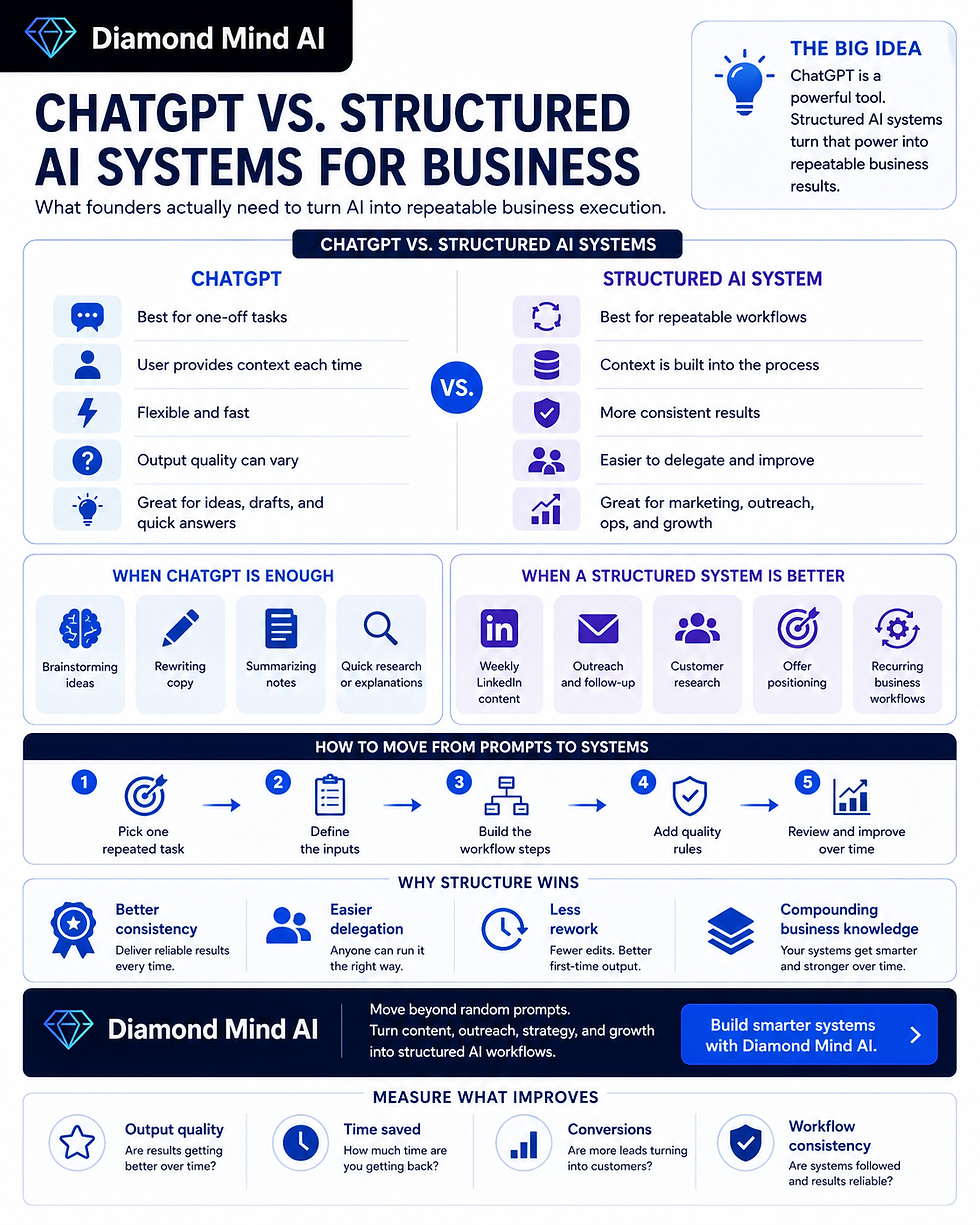
ChatGPT vs. Structured AI Systems
ChatGPT and structured AI systems are not enemies.
They solve different problems.
ChatGPT is excellent for flexible, open-ended work.
Structured AI systems are better for repeated business workflows.
Category | ChatGPT | Structured AI System |
Best use | Flexible tasks | Repeatable workflows |
Context | Can reuse project context, subject to settings | Built into the system |
Output consistency | Variable | More consistent |
Delegation | Depends on prompting skill | Easier to delegate |
Business memory | Limited by setup | Designed to compound |
Quality control | Manual | Built into workflow |
Conversion path | User-defined | System-defined |
Best for | Ideas, drafts, analysis | Marketing, outreach, ops, growth |
The best setup is not ChatGPT or structured systems.
The best setup is ChatGPT inside structured systems.
That is where Diamond Mind AI fits.
When ChatGPT Is Enough
ChatGPT is enough when the task is simple, one-off, or exploratory.
Examples:
brainstorming names
rewriting a short paragraph
summarizing a simple note
explaining a topic
creating rough ideas
checking grammar
drafting a quick reply
asking for alternative wording
In these cases, a full system may be unnecessary.
You do not need a workflow for every small task.
The issue starts when the task repeats and matters to the business.
If you write LinkedIn posts every week, you need a system.
If you send outreach emails every week, you need a system.
If you analyze customer feedback every month, you need a system.
If you prepare campaign briefs regularly, you need a system.
Repeated work should not depend on random prompting.
When a Structured AI System Is Better
A structured AI system is better when the workflow is repeated, strategic, or tied to revenue.
Examples include:
content planning
LinkedIn campaigns
outbound outreach
offer positioning
customer research
SEO article briefs
sales follow-up
proposal drafting
meeting summaries
performance reviews
SOP creation
These tasks need more than a good first draft.
They need consistency.
They need context.
They need review rules.
They need a next action.
They need improvement over time.
That is especially important because generative AI is moving from experimentation into daily workflows, and governance is becoming more important as adoption scales. LexisNexis’ 2026 Future of Work Report found that generative AI is rapidly transforming professional workflows, but policy and oversight are not keeping pace, creating a need for stronger controls and trusted outcomes.
For small businesses, that does not mean complicated bureaucracy.
It means using simple systems that reduce chaos.
The Founder Problem: AI Creates More Output, Not Always More Progress
Founders often assume that more AI output equals more progress.
That is not always true.
More posts do not automatically mean better positioning.
More emails do not automatically mean more replies.
More ideas do not automatically mean better decisions.
More automation does not automatically mean better execution.
AI can create volume.
But volume without direction creates noise.
A structured system forces the business to answer better questions first:
Who are we trying to reach?
What outcome do we want?
What offer are we supporting?
What message are we reinforcing?
What action should happen next?
How will we know if it worked?
Those questions are what turn AI from a content generator into a business tool.
The Risk of AI Slop
One of the biggest risks of random AI use is low-quality, generic output.
People often call this “AI slop.”
It looks polished, but it lacks insight, context, judgment, or usefulness.
For a business, this can show up as:
generic LinkedIn posts
vague website copy
bloated emails
shallow blogs
weak strategy memos
repetitive ads
empty thought leadership
The problem is not that AI cannot help.
The problem is that the workflow is not strong enough.
A better system reduces AI slop by giving the AI:
clearer inputs
stronger constraints
better examples
sharper audience context
quality rules
review steps
This is why the future of AI for business is not just more generation.
It is better workflow design.
A 2026 study of Microsoft 365 Copilot adoption found that generative AI showed the most value
for clearly structured, text-based tasks and highlighted the need for context-sensitive implementation, role-specific training, and governance.
That supports the same principle:
AI works better when the workflow is structured.
The Diamond Mind AI Approach
Diamond Mind AI is being developed around a structured business-system approach that connects business context, workflows, content, strategy, and human review. It is in private testing; public signup is not currently open.
A generic chatbot waits for the user to know what to ask.
The aim is to make business workflow structure part of the experience.
The examples below illustrate that approach.
The examples below illustrate workflow design rather than a list of publicly available product features.
For example, instead of asking:
“Write a LinkedIn post.”
A structured LinkedIn workflow can ask for:
audience
offer
topic angle
hook
proof point
CTA
tone
refinement
follow-up ideas
Instead of asking:
“Create an outreach message.”
A structured outreach workflow can ask for:
prospect type
pain point
offer fit
credibility point
message angle
follow-up sequence
referral ask
Instead of asking:
“Help me with strategy.”
A structured strategy workflow can ask for:
current situation
market context
audience
offer
constraints
options
tradeoffs
recommended next step
That is the value.
The system improves the thinking process before the output is created.
A Practical Example: A Single Prompt vs. a Structured Workflow
Here is the difference in practice.
Basic ChatGPT prompt
“Write me a LinkedIn post about how AI helps founders save time.”
This may produce a decent post.
But it will probably be generic.
Structured AI workflow
Goal: Create a LinkedIn post that positions Diamond Mind AI as a system for founders who want structured AI workflows.
Audience: Founders and marketers already using ChatGPT but struggling with repeatability.
Point of view: AI does not create leverage until it becomes part of a repeatable business process.
Proof angle: Random prompts create output, systems create consistency.
Tone: Clear, practical, direct, not hype-driven.
CTA: Invite readers to learn about the Diamond Mind AI approach and current access status.
That workflow will produce a better post because the thinking is sharper.
The AI is not guessing.
It is executing within strategy.
How to Move From ChatGPT Prompts to AI Systems
The transition does not need to be complicated.
Start with one repeated workflow.
Good examples include:
weekly LinkedIn content
customer research
sales follow-up
blog planning
outreach messages
meeting summaries
offer positioning
Then turn it into a system.
Step 1: Define the outcome
What result should this workflow produce every time?
Example:
“Create three LinkedIn posts per week that explain our offer and point readers to relevant educational material.”
Step 2: Define the inputs
What information does the AI need?
Examples:
audience
offer
tone
topic
proof point
CTA
product page
examples
Step 3: Define the workflow
What are the repeatable steps?
Examples:
Choose content pillar.
Generate angles.
Select strongest idea.
Draft post.
Improve hook.
Add CTA.
Review for brand fit.
Create variations.
Step 4: Define quality rules
What makes the output good?
Examples:
no generic AI language
clear point of view
practical example
short paragraphs
no hype
one CTA
aligned with offer
Step 5: Review and improve
Track what works.
Then improve the system.
This is how a prompt becomes a workflow.
And this is how a workflow becomes an AI business system.
Common Mistakes to Avoid
Mistake 1: Thinking ChatGPT alone is the strategy
ChatGPT is useful.
But it is not the strategy.
The strategy is your audience, offer, positioning, workflow, and conversion path.
Mistake 2: Saving prompts without building workflows
A folder of prompts is better than nothing.
But it is still not a system.
A system defines when to use the prompt, what inputs it needs, how to review the output, and what action comes next.
Mistake 3: Automating too early
Do not automate a messy process.
First, structure the workflow.
Then automate parts of it.
Mistake 4: Measuring productivity instead of business impact
Saving time is useful.
But the better question is:
Did the workflow improve output quality, consistency, conversion, or decision-making?
Mistake 5: Letting AI erase your point of view
AI should help express your thinking.
It should not replace your thinking.
The strongest business AI systems preserve the user’s judgment while reducing execution friction.
Final Thought
ChatGPT is one of the most powerful business tools available.
But a tool is not the same as a system.
For founders and small teams, the real opportunity is not simply asking better prompts.
The opportunity is turning repeated business work into structured AI workflows.
That is how you move from random output to repeatable execution.
From scattered ideas to consistent growth.
From one-off productivity to operating leverage.
That is the shift Diamond Mind AI is built for.
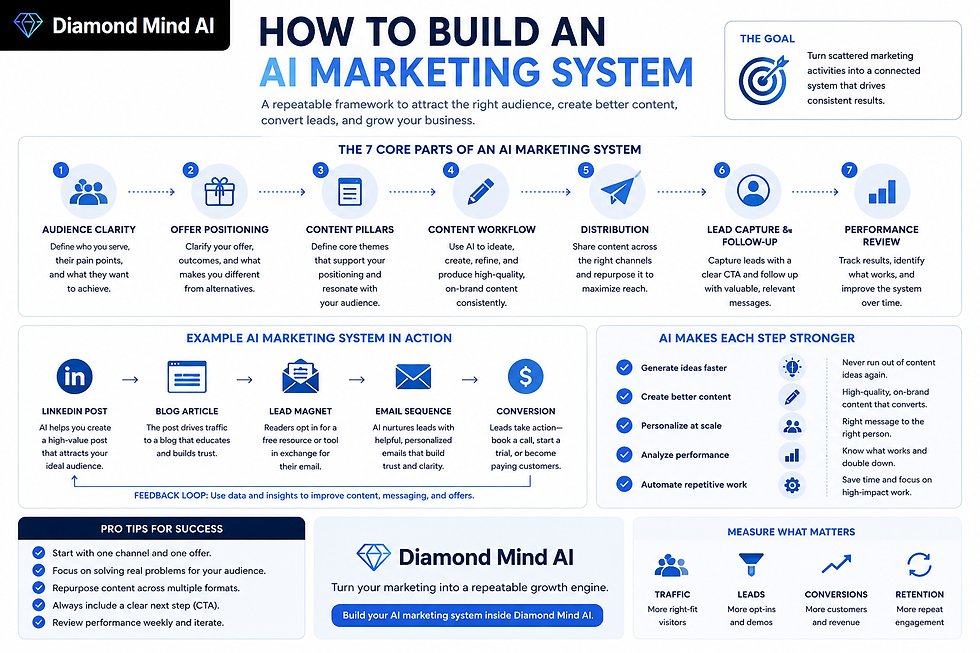
Explore the Diamond Mind AI approach to connecting business context with structured workflows for content, outreach, strategy, and growth. Public signup is not currently open.


Comments