
AI Workflow Automation Trends: What Small Businesses Should Actually Use in 2026

Updated: May 18
AI workflow automation is moving fast.
Every week, there is a new tool, agent, integration, or platform claiming it can automate your business.
For founders and small teams, that creates a problem.
The opportunity is real.
The noise is also real.
The question is not whether AI workflow automation matters.
It does.

The better question is:
Which AI workflow automation trends are actually useful for small businesses right now?
An AI workflow automation is a repeatable process where AI helps move work from one step to the next. It may summarize information, generate content, classify leads, route tasks, trigger follow-ups, update systems, or recommend next actions.
The best versions do not just create output.
They improve execution.
That is where small businesses should focus.
What Is AI Workflow Automation?
AI workflow automation uses artificial intelligence to help complete business workflows with less manual effort.
Traditional automation usually follows fixed rules.
For example:
If someone fills out a form, send an email.
If a deal moves stages, create a task.
If an invoice is overdue, send a reminder.
That is useful.
But AI workflow automation can go further.
It can:
summarize messy information
classify customer requests
draft personalized replies
extract insights from documents
recommend next actions
generate marketing assets
compare options
flag exceptions
route work based on context
That means automation is moving from simple triggers to more intelligent workflows.
A 2026 workflow automation analysis describes this shift as moving from predefined sequences toward agentic workflows where AI can read context, make decisions, draft responses, update systems, and decide whether human help is needed.
That is a major shift.
But small businesses should not jump into full autonomy too quickly.
The winning move is to automate carefully, starting with workflows that are repeated, low-risk, and easy to review.
Why AI Workflow Automation Matters for Small Businesses
Small businesses usually do not lose because they lack ideas.
They lose time to repeated work.
Common examples include:
rewriting similar emails
manually summarizing calls
creating weekly content from scratch
chasing follow-ups
rebuilding proposals
updating spreadsheets
reviewing messy notes
researching competitors
documenting processes
AI workflow automation can reduce that drag.
But the bigger benefit is not just speed.
The bigger benefit is consistency.
When a workflow is structured, the business does not depend entirely on one person remembering the process.
The system carries part of the operational memory.
That matters for founders, consultants, agencies, and lean teams because they are usually operating with limited time, limited staff, and too many priorities.
AI workflow automation helps them create operating leverage without immediately hiring more people.
Trend 1: Agentic Workflows Are Replacing Simple Automations
The biggest trend in AI workflow automation is the rise of agentic workflows.
A basic automation follows instructions.
An agentic workflow can interpret a goal, reason through steps, use tools, and adapt based on context.
For example, a basic automation might say:
“When a form is submitted, send a welcome email.”
An agentic workflow might say:
“Review the form submission, classify the lead, summarize their needs, recommend the next action, draft a personalized email, and create a CRM note.”
That is a different level of workflow.
It is not just faster.
It is more context-aware.
Current research on agentic business process management argues that generative and agentic AI is pushing workflow automation from task-level automation toward autonomy, reasoning, and data-driven process management.
For small businesses, the practical takeaway is simple:
Do not start by trying to automate everything.
Start by adding AI judgment to one workflow.
Good first use cases include:
lead qualification
customer intake summaries
meeting notes
content repurposing
sales follow-up drafting
support request classification
Trend 2: Human-in-the-Loop Automation Is Becoming the Safe Default
Fully autonomous AI sounds exciting.
But for most small businesses, full autonomy is not the right first step.
The safer model is human-in-the-loop automation.
That means AI performs part of the work, but a human reviews or approves the final action.
Examples:
AI drafts the email, but a person sends it.
AI summarizes a sales call, but a salesperson reviews it.
AI scores a lead, but a sales admin confirms routing.
AI writes a blog outline, but a marketer approves it.
AI generates a proposal draft, but leadership reviews pricing and terms.
This is the best starting point for small teams.
It gives you speed without losing control.
It also reduces the risk of mistakes, off-brand messaging, or bad decisions.
Enterprise AI governance is moving in the same direction. Kyndryl’s 2026 announcement around policy-governed agentic AI focuses on guardrails, compliance, transparency, and auditable workflows for trusted deployment.
Small businesses do not need enterprise-level policy systems.
But they do need simple approval points.
Rule of thumb:
Automate drafts before you automate decisions.
Trend 3: Pre-Built AI Workflows Are Becoming More Valuable Than Raw Tools
Another major trend is the rise of pre-built workflows.
This matters because most small businesses do not want to engineer AI systems from scratch.
They want useful workflows they can run immediately.
That is why workflow templates, AI skills, connectors, and pre-built automations are becoming more important.
Anthropic recently launched Claude for Small Business with pre-built connectors and ready-to-run agentic workflows across functions like finance, sales, HR, marketing, and customer service, aimed at making AI adoption easier for SMBs and solopreneurs.
That validates Diamond Mind AI’s core direction.
The market is moving from:
“Here is a blank AI tool.”
to:
“Here is a workflow you can use for a real business outcome.”
That is exactly where founders need help.
They do not need more blank screens.
They need guided systems.
Trend 4: AI Workflow Tools Are Splitting Into Two Categories
AI workflow tools are starting to split into two practical categories.
The first category is automation-first tools.
These include tools built around integrations, triggers, and system connections.
They are useful when the workflow depends on moving data between platforms.
Examples include workflows that connect forms, CRMs, email tools, spreadsheets, calendars, and project management systems.
The second category is AI-native workflow tools.
These are built around reasoning, prompts, knowledge bases, agents, and outputs.
They are useful when the workflow depends on interpretation, analysis, content generation, or decision support.
Recent AI-native workflow tool coverage describes this segment as platforms built around LLM reasoning, natural language interfaces, and autonomous execution rather than traditional API connectors.
Small businesses need both categories eventually.
But they should not overbuild early.
The right sequence is:
Start with a manual AI workflow.
Turn it into a reusable template.
Add automation where it saves real time.
Add integrations only after the workflow proves useful.
That sequence prevents wasted tool spending.
Trend 5: Workflow Governance Is Becoming a Competitive Advantage
As AI becomes more powerful, governance becomes more important.
Governance does not mean bureaucracy.
It means the business knows:
what AI is allowed to do
what it is not allowed to do
what data it can use
who approves final outputs
what quality rules apply
when a human must review
how decisions are documented
This matters because AI can make mistakes confidently.
It can also produce outputs that sound good but are wrong, generic, or risky.
For small businesses, governance can be simple.
Use rules like:
AI can draft, but humans approve public content.
AI can summarize, but humans verify key facts.
AI can recommend, but humans decide.
AI can personalize emails, but humans approve first-contact outreach.
AI can organize data, but humans confirm important changes.
Research on authenticated workflows for agentic AI describes four key security boundaries for enterprise agents: prompts, tools, data, and context. It argues that policy enforcement and workflow integrity are necessary as agentic systems automate more enterprise work.
The small-business version is less technical but equally important:
Know where the AI is allowed to act.
Know where it must stop.
Trend 6: AI Is Moving From Content Creation to Business Execution
Many people still think of AI as a content tool.
That is too narrow.
AI can write posts and emails, but the bigger opportunity is business execution.
AI workflow automation can support:
sales follow-up
lead scoring
customer onboarding
proposal drafting
meeting summaries
SOP creation
competitive research
customer support triage
content repurposing
performance analysis
The shift is from “write this for me” to “help me run this process.”
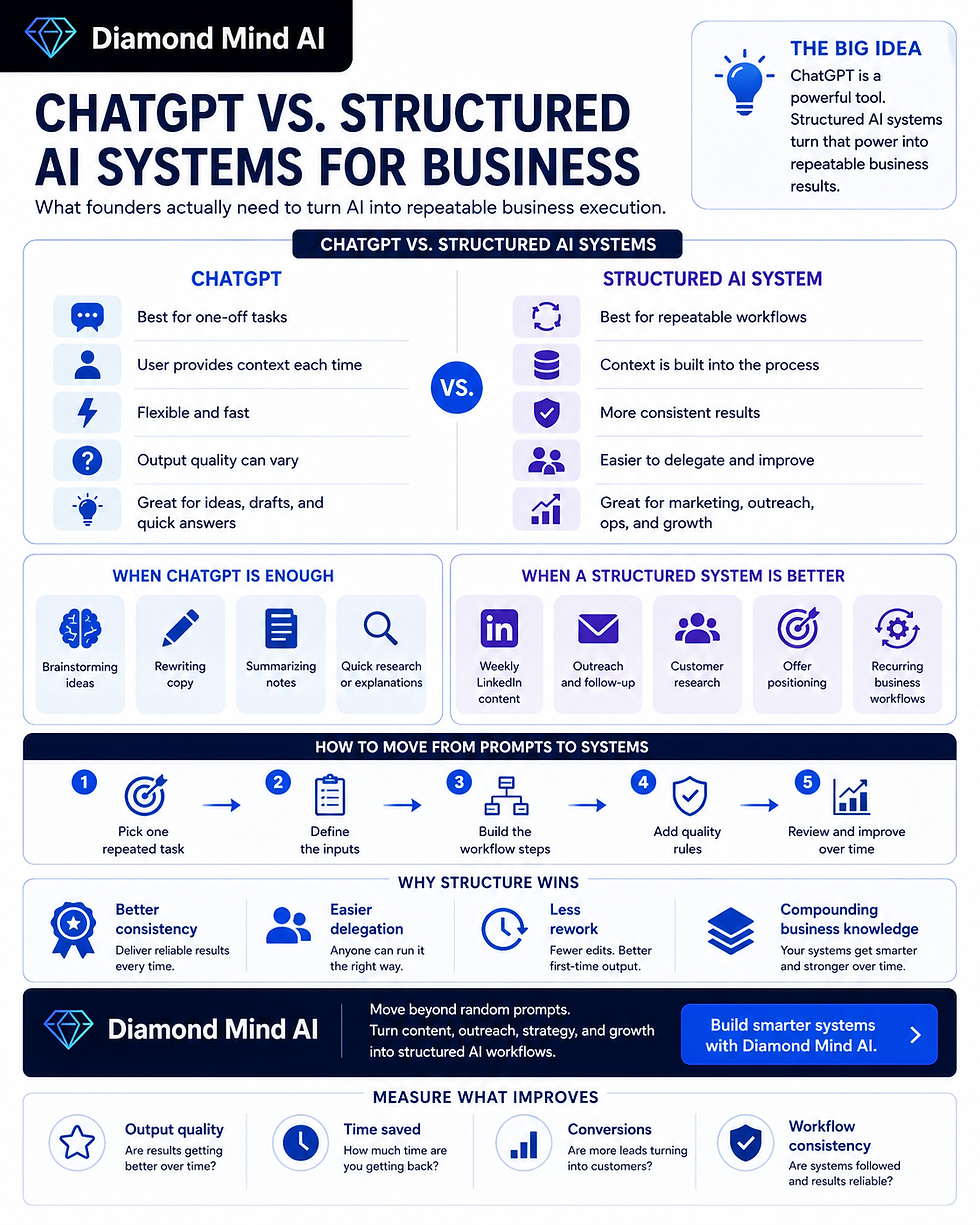
That is the core idea behind Diamond Mind AI.
The value is not just better prompts.
The value is structured workflows that help users move from idea to execution.
Trend 7: Simple AI Automations Will Beat Complex Ones for Most Small Teams
The biggest mistake small businesses make is overcomplicating automation.
They try to build the perfect AI system before they have a clear workflow.
That usually fails.
The better approach is to start with simple, high-frequency workflows.
Strong first automations include:
turn call notes into follow-up emails
turn one blog into five LinkedIn posts
turn a lead form into a qualification summary
turn meeting notes into action items
turn customer reviews into messaging insights
turn a campaign idea into a content calendar
turn competitor pages into positioning notes
These are useful because they are:
repeated often
easy to review
tied to business outcomes
low-risk if a human approves them
simple enough to improve over time
Small teams do not need advanced autonomy on day one.
They need repeatable wins.
The Best AI Workflow Automation Starting Point
The best starting point depends on your business.
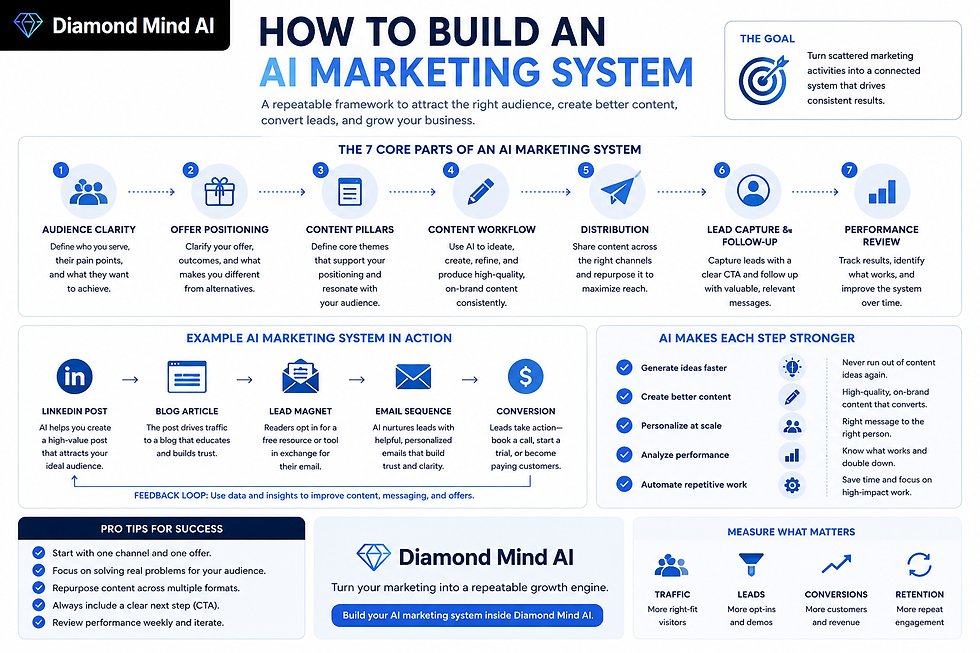
But for most founders, marketers, and consultants, the first workflow should be tied to growth.
That means content, outreach, follow-up, or customer research.
A strong starting workflow looks like this:
Workflow: Turn one topic into a full marketing cycle.
Inputs:
audience
offer
topic
proof point
CTA
channel
tone
Process:
Generate five angles.
Pick the strongest angle.
Draft one long-form post or article section.
Create three LinkedIn posts.
Create one email.
Add CTA.
Review for brand fit.
Publish.
Track response.
Use performance to improve the next cycle.
Output:
one article section
three LinkedIn posts
one email
one CTA
one performance summary
This is a practical AI workflow automation because it creates visible business value quickly.
It also connects directly to Diamond Mind AI’s strongest early product use case.
Where Diamond Mind AI Fits
Diamond Mind AI helps founders and marketers avoid the biggest mistake in AI automation:
Starting with tools before building the workflow.
The platform is designed to help users turn scattered AI tasks into structured systems across:
content
outreach
marketing
strategy
operations
research
growth planning
That is different from giving users a blank chatbot.
Diamond Mind AI gives users a guided structure.
The user still brings judgment, context, and goals.
The system helps turn that into repeatable execution.
As AI workflow automation becomes more advanced, structure becomes more valuable.
The businesses that win will not be the ones using the most tools.
They will be the ones building the clearest workflows.
Common Mistakes to Avoid
Mistake 1: Automating before defining the workflow
If the process is unclear, automation will make confusion faster.
Define the workflow first.
Then automate.
Mistake 2: Giving AI too much control too soon
Start with drafts, summaries, and recommendations.
Do not start with unsupervised decisions.
Mistake 3: Buying tools before proving the use case
Do not buy a complex automation stack before proving the workflow manually.
Start simple.
Then scale.
Mistake 4: Ignoring data quality
AI workflows depend on the information you give them.
Bad inputs create bad outputs.
Mistake 5: Measuring time saved only
Time saved matters.
But also track quality, consistency, conversion, and reduced rework.
Final Thought
AI workflow automation is becoming one of the most important business shifts of 2026.
But small businesses should not chase every trend.
They should focus on the trends that create practical leverage:
Agentic workflows.
Human approval.
Reusable templates.
Simple automations.
Workflow governance.
Business execution.
The goal is not to automate everything.
The goal is to build repeatable systems that make the business easier to run.
That is where AI becomes valuable.
Not as a gimmick.
Not as a random prompt.
But as part of the operating system of the business.
Ready to turn AI automation ideas into real business workflows? Use Diamond Mind AI to structure your content, outreach, strategy, and growth systems before you automate them.

Comments