
How to Build an AI Marketing System Without Starting From Scratch

Updated: 3 hours ago
Most businesses do not have a marketing problem.
They have a marketing system problem.
They create posts when they remember.
They send emails when they need leads.
They update their website when something feels outdated.
They run campaigns without a clear follow-up process.
Then they wonder why marketing feels inconsistent.
AI can help, but only if it is used with structure.
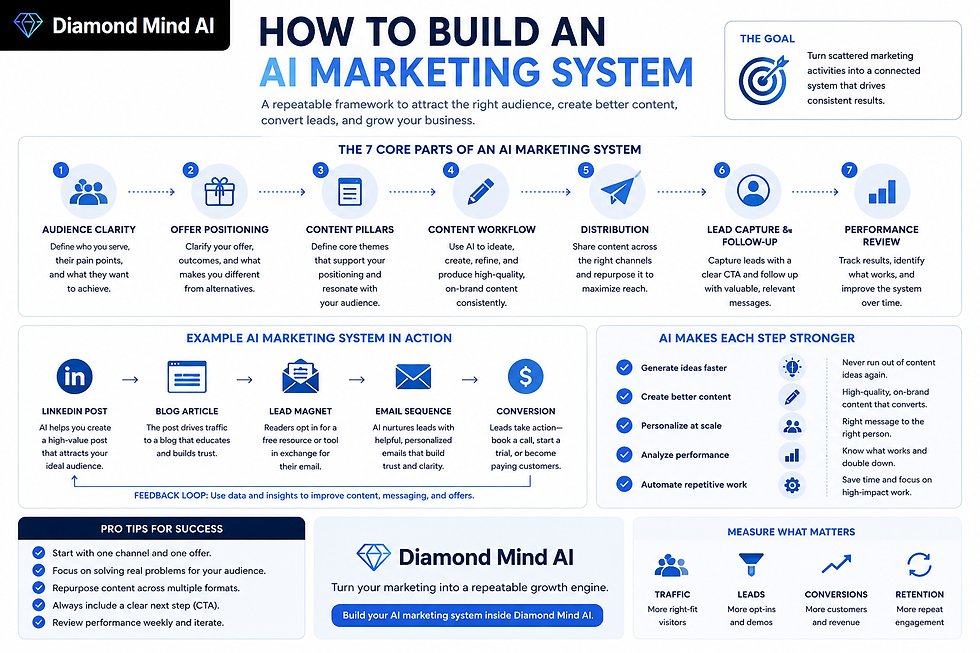
An AI marketing system is a repeatable workflow that uses AI to plan, create, publish, distribute, and improve marketing activity.
It is not just using ChatGPT to write a caption.
It is not just generating random blog ideas.
It is not just automating emails.
A real AI marketing system connects strategy, content, outreach, conversion, and performance review into one repeatable process.
That is where the leverage comes from.
What Is an AI Marketing System?
An AI marketing system is a structured process that helps a business execute marketing consistently using AI.
It usually includes:
audience definition
offer positioning
content planning
content creation
distribution
lead capture
follow-up
performance review
iteration
The key word is system.
A system means the process can be repeated.
That matters because marketing does not work when it is random.
A single LinkedIn post is not a marketing system.
A one-time email blast is not a marketing system.
A landing page without follow-up is not a marketing system.
A real system connects the pieces.
For example:
A founder publishes a LinkedIn post.
That post drives traffic to a blog.
The blog sends readers to a free workflow or signup page.
The signup triggers an email sequence.
The email sequence moves the user toward a paid plan.
The performance data improves the next campaign.
That is a marketing system.
AI helps each step move faster, but the structure is what makes it work.
Why Most AI Marketing Fails
Most AI marketing fails because people start with tools instead of strategy.
They ask:
“What AI tool should I use?”
That is the wrong first question.
The better question is:
“What marketing outcome do I need to produce repeatedly?”
Do you need more content?
More leads?
Better conversion?
More follow-up?
Better positioning?
More consistent outreach?
Each of those requires a different workflow.
AI cannot fix unclear strategy.
It can only amplify it.
If the message is weak, AI will create more weak messaging.
If the audience is unclear, AI will create vague content.
If the offer is confusing, AI will generate polished copy that still does not convert.
This is why the first step in building an AI marketing system is not automation.
It is clarity.
The Core Parts of an AI Marketing System
A strong AI marketing system has seven core parts.
1. Audience Clarity
Before AI creates anything, the system needs to know who the marketing is for.
A weak audience definition sounds like this:
“Small business owners.”
That is too broad.
A stronger audience definition sounds like this:
“Founders and marketers who use ChatGPT but still struggle to turn AI outputs into repeatable business workflows.”
That is much better.
It tells the AI:
who the person is
what problem they have
what they are already trying
what outcome they want
Audience clarity improves every part of the system.
It improves content ideas.
It improves hooks.
It improves email copy.
It improves landing page messaging.
It improves offers.
Without audience clarity, AI produces generic marketing.
With audience clarity, AI can support sharper positioning.
2. Offer Positioning
Your AI marketing system needs a clear offer.
That means the system should understand:
what you sell
who it is for
what problem it solves
what outcome it creates
why it is different
what proof supports it
For Diamond Mind AI, a simplified offer could be:
“Diamond Mind AI helps founders and marketers turn scattered AI prompts into structured business systems for content, outreach, strategy, and growth.”
That sentence gives the system direction.
Now the AI knows what the marketing should support.
Without that, content becomes disconnected.
One post talks about productivity.
Another talks about ChatGPT.
Another talks about entrepreneurship.
Another talks about automation.
None of it compounds.
A clear offer gives every piece of marketing a center of gravity.
3. Content Pillars
Content pillars are the repeatable themes your marketing system uses.
For Diamond Mind AI, strong content pillars could include:
AI business systems
AI marketing workflows
founder productivity
LinkedIn content planning
outreach systems
structured prompting
business clarity
AI templates
growth workflows
These pillars prevent random posting.
They also help SEO because your blog, LinkedIn, email, and product pages start reinforcing the same topics.
The goal is not to create infinite content ideas.
The goal is to create consistent market association.
When people see Diamond Mind AI repeatedly, they should understand the same core message:
This is where founders go to turn AI into structured business execution.
That is the category.
That is the positioning.
That is what the marketing system should reinforce.
4. Content Production Workflow
Once the audience, offer, and pillars are clear, you need a repeatable content workflow.
A simple AI content workflow looks like this:
Select the audience.
Choose the business objective.
Pick a content pillar.
Generate topic angles.
Select the strongest angle.
Draft the content.
Improve the hook.
Add proof or example.
Add CTA.
Review for brand fit.
Publish.
Track performance.
That workflow can be used for:
LinkedIn posts
blogs
emails
landing pages
short-form scripts
lead magnets
This is where AI becomes useful.
Instead of asking AI to “write content,” the system guides AI through a repeatable process.
That creates better output.
It also makes the work easier to delegate.
5. Distribution System
Content creation is only one part of marketing.
Distribution is what gets the content seen.
A simple distribution system may include:
publishing on LinkedIn
emailing the article to a list
repurposing blog content into social posts
using the article in outreach
linking from related blog posts
sharing in founder communities
sending to warm prospects
Most businesses under-distribute their best ideas.
They create something once and move on.
An AI marketing system should help repurpose and distribute content across multiple channels.
For example, one blog article can become:
five LinkedIn posts
one email newsletter
one short founder note
one lead magnet section
one sales enablement asset
one outreach talking point
This makes the original work more valuable.
It also helps the brand show up consistently without creating everything from scratch.
6. Lead Capture and Follow-Up
Marketing should create movement.
That movement may be:
signup
demo request
free workflow access
newsletter subscription
waitlist join
sales call
paid account
This means every AI marketing system needs a conversion path.
For a product that has launched and offers a free resource, an illustrative path could be:
Blog article → useful free resource → permission-based follow-up → a relevant offer
This is an illustrative funnel for a launched product, not Diamond Mind AI’s current access or commercial offer.
A useful next step should fit what the business can actually provide today.
The system needs to answer:
What should the reader do next?
Why should they do it now?
What value do they get immediately?
How do we follow up?
AI can help write the emails, landing pages, and CTAs, but the funnel logic needs to be clear first.
7. Performance Review
A real AI marketing system improves over time.
That means it needs performance review.
Track:
which topics drive traffic
which posts get engagement
which CTAs get clicks
which landing pages convert
which emails get replies
which workflows activate users
which users become paid customers
Then use the data to improve the system.
For example:
If LinkedIn posts about “AI business systems” outperform posts about “AI tools,” create more content around systems.
If readers click one educational-resource CTA more than another, investigate whether that resource better matches their needs.
If users sign up but do not activate, improve onboarding.
AI should not only generate marketing assets.
It should help interpret performance and recommend the next test.
That is how the marketing system compounds.
An Illustrative AI Marketing System for Diamond Mind AI
The following is a planning example, not a live funnel or a launch commitment. Diamond Mind AI is in private testing; public signup is not currently open.
Step 1: Define the core audience
Primary audience:
Founders, marketers, consultants, and operators who already use AI but struggle to turn it into repeatable business execution.
Step 2: Define the core offer
The intended offer connects business context with structured AI workflows across marketing, outreach, strategy, and growth.
Step 3: Choose a next step that is available today
Start with a relevant public educational article or a clear explanation of the current access status.
Only offer a planner, trial, or workflow once it is available and the access terms are confirmed.
Step 4: Build content around five SEO pillars
The initial SEO cluster should include:
AI business systems
AI workflow templates
AI marketing systems
AI workflow automation
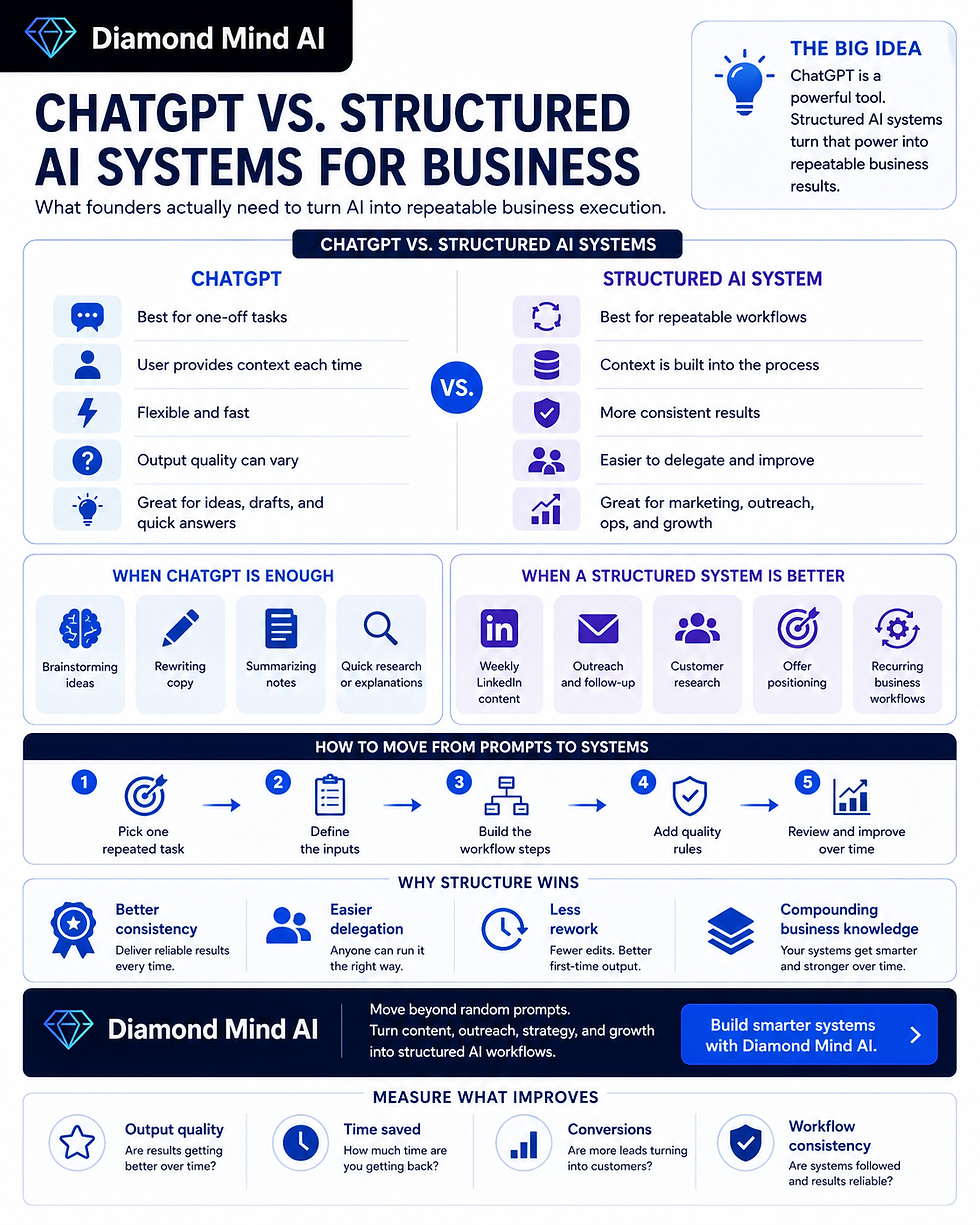
ChatGPT vs structured AI systems
Step 5: Repurpose each blog into LinkedIn content
Each article should become:
one founder story post
one educational post
one mistake-based post
one tactical checklist
one CTA post
Step 6: Connect readers to a relevant next step
Each article should point to useful information that is actually available.
For this planning example, a suitable CTA is:
“Explore the Diamond Mind AI approach to structured business workflows.”
Step 7: Review performance every two weeks
Look at:
organic traffic
LinkedIn clicks
CTA clicks
content engagement
reader questions
feedback received
future activation and conversion measures once access is available
Then adjust the next content cycle based on what is working.
Example AI Marketing Workflow Template
Here is a reusable template for one weekly marketing cycle.
Weekly AI Marketing System
Goal: Create and distribute one week of marketing content that supports a specific offer.
Inputs:
target audience
offer
content pillar
proof point
CTA
preferred tone
channel
campaign goal
Workflow:
Select one business objective.
Choose one content pillar.
Generate five topic angles.
Pick the strongest two.
Draft one blog section or long-form post.
Turn it into three LinkedIn posts.
Create one email version.
Add CTA to each asset.
Review for clarity and brand fit.
Publish.
Track performance.
Feed learnings into next week.
Output:
one article or long-form post
three LinkedIn posts
one email
one CTA
one performance summary
Review questions:
Did the content support the offer?
Was the audience specific?
Was the CTA clear?
Did the content drive clicks or replies?
What should be repeated next week?
This is the kind of workflow that turns AI from a writing assistant into a marketing operating system.
Common Mistakes to Avoid
Mistake 1: Using AI before clarifying the offer
AI cannot fix a weak offer.
Clarify the offer first.
Then use AI to communicate it better.
Mistake 2: Creating content without a conversion path
A post without a next step may build awareness, but it does not create a system.
Every article, post, and email should point somewhere useful.
Mistake 3: Publishing on too many channels
Small teams should not start with six channels.
Start with one primary channel, one supporting channel, and one conversion path.
For Diamond Mind AI while public signup is closed, an illustrative path is:
LinkedIn → blog → relevant educational article or current access information
Mistake 4: Measuring vanity metrics only
Likes are useful signals, but they are not the whole story.
Track clicks, signups, activation, and paid conversion.
Mistake 5: Treating AI as the marketer
AI is not the marketer.
AI is the execution layer.
The strategy still needs human judgment.
Where Diamond Mind AI Fits
Diamond Mind AI is being developed for people who want to connect AI with business context, structured workflows, and human judgment.
The broader design direction includes:
content planning
LinkedIn campaigns
outreach
messaging
strategy
growth workflows
business clarity
That matters because most founders do not have time to build every workflow from scratch.
A useful system should make inputs, steps, and review criteria clear.
The intended shift is from:
“Write me a post.”
to:
“Build me a campaign that supports this offer, reaches this audience, and drives this next action.”
That is the shift.
It is not just better prompting.
It is better marketing architecture.
Final Thought
AI marketing is not about creating more content.
It is about creating a better system.
A real AI marketing system helps a business clarify its audience, define its offer, create consistent content, distribute it properly, capture leads, follow up, and improve over time.
That is what turns AI into leverage.
Without a system, AI creates disconnected assets.
With a system, AI supports repeatable growth.
For founders, marketers, and small teams, that difference matters.
The goal is not to sound more automated.
The goal is to operate with more clarity.
Explore the Diamond Mind AI approach to structured business workflows. Public signup is not currently open; the examples above do not offer a live planner or paid plan.


Comments