
AI Workflow Templates for Small Business: 10 Repeatable Systems You Can Use

Updated: 3 hours ago
Most small businesses do not need more random AI prompts.
They need repeatable workflows.

That is where AI workflow templates become valuable.
An AI workflow template is a reusable structure that helps you complete a business task with the right context, steps, inputs, and quality checks.
Instead of starting from scratch every time, you follow a proven sequence.
That sequence helps AI produce better work.
For small businesses, this matters because time, budget, and attention are limited. Founders and lean teams cannot afford to rebuild the same process every week.
They need systems that help them move faster without lowering quality.
What Is an AI Workflow Template?
An AI workflow template is a structured process that guides AI through a specific business task.
It usually includes:
the goal
the audience
the required inputs
the step-by-step workflow
the output format
the review criteria
the next action
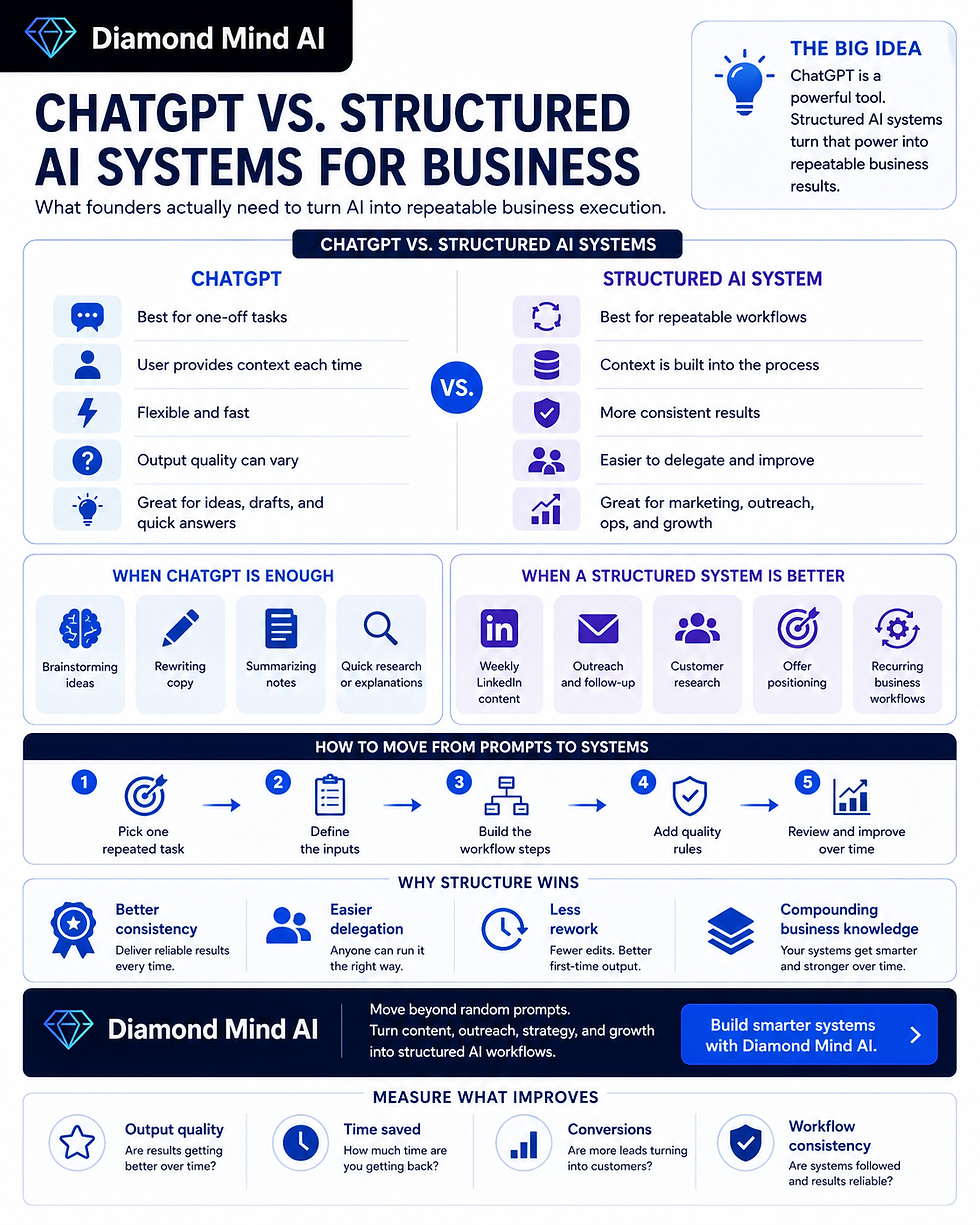
A prompt tells AI what to do once.
A workflow template tells AI how to complete a task repeatedly.
That is the difference.
For example, a basic prompt might say:
“Write me a LinkedIn post about my company.”
An AI workflow template would ask:
Who is the target audience?
What is the business goal?
What offer should the post support?
What tone should the post use?
What proof point should be included?
What CTA should appear at the end?
What format should the post follow?
The result is usually better because the template forces the right thinking before the output is created.
This is why workflow structure is becoming more important in business AI adoption. Current AI workflow automation tools are moving beyond simple trigger-based automation and into workflows that can analyze documents, enrich records, generate assets, route approvals, and update data across systems.
Why Small Businesses Need AI Workflow Templates
Small businesses usually do not have large teams.
The founder may handle strategy, sales, marketing, content, operations, and customer communication in the same week.
That creates constant context switching.
AI can help, but only if it is used with structure.
Without templates, AI often creates inconsistent outputs.
One day the content sounds polished.
The next day it sounds generic.
One sales email is sharp.
The next one misses the offer.
One strategy memo is useful.
The next one is too vague.
Templates reduce that variation.
They make AI easier to reuse, delegate, and improve.
For a small business, this creates five practical benefits:
Faster execution
Better consistency
Less rework
Easier delegation
More reusable business knowledge
The advantage is not just speed.
The advantage is repeatability.
AI Workflow Templates vs. AI Prompts
AI prompts are useful.
But prompts are usually one-off instructions.
AI workflow templates are more complete.
They give AI a process to follow.
Item | Prompt | Workflow Template |
Use case | One task | Repeated process |
Context | Limited | Structured |
Quality | Variable | More consistent |
Delegation | Harder | Easier |
Improvement | Manual | Repeatable |
A prompt can help you create one asset.
A workflow template can help you create a repeatable business function.
The 10 AI Workflow Templates Small Businesses Should Build First
Below are the 10 most useful AI workflow templates for a small business.
These are not random content ideas.
These are business systems that can be repeated weekly or monthly.
1. AI Content Planning Template
Purpose: Create a weekly or monthly content plan.
Best for: Founders, consultants, marketers, agencies, creators.
Inputs needed:
target audience
business offer
content goal
key themes
preferred platform
tone of voice
proof points
CTA
Workflow:
Define the audience.
Select the business objective.
Generate topic themes.
Turn themes into post ideas.
Assign each idea to a content format.
Add CTA direction.
Organize into a calendar.
Review for brand fit.
Output: A weekly or monthly content calendar.
Why it matters: Most small businesses struggle with consistency. This workflow turns content creation from a daily guessing game into a repeatable system.
2. AI LinkedIn Post Template
Purpose: Create high-quality LinkedIn posts that support brand authority and lead generation.
Best for: Founders, executives, consultants, B2B service providers.
Inputs needed:
topic
audience
point of view
example or story
business relevance
CTA
Workflow:
Clarify the post objective.
Select the audience pain point.
Write three hook options.
Pick the strongest hook.
Draft the post.
Remove generic language.
Add a soft CTA.
Create two variations.
Output: One polished LinkedIn post plus variations.
Why it matters: LinkedIn content is one of the highest-leverage channels for founders and consultants. But without a repeatable workflow, posting becomes inconsistent.
3. AI Customer Research Template
Purpose: Understand customer pain points, objections, motivations, and buying triggers.
Best for: Founders, marketers, product teams, consultants.
Inputs needed:
target customer
product or service
customer reviews
sales call notes
competitor messaging
survey responses
Workflow:
Define the customer segment.
Collect customer language.
Identify recurring pain points.
Extract objections.
Identify desired outcomes.
Summarize buying triggers.
Convert insights into messaging recommendations.
Output: Customer insight summary and messaging angles.
Why it matters: Better customer research improves content, landing pages, sales emails, offers, and product decisions.
4. AI Offer Positioning Template
Purpose: Clarify what you sell, who it is for, and why it matters.
Best for: Startups, consultants, agencies, service businesses.
Inputs needed:
product or service
target audience
customer problem
desired outcome
proof points
competitors
pricing model
Workflow:
Define the core customer.
State the main problem.
Identify the desired outcome.
Clarify the unique mechanism.
Compare against alternatives.
Write the offer in one sentence.
Create three positioning variations.
Pressure-test for clarity.
Output: A clear offer statement and positioning options.
Why it matters: Weak positioning makes every marketing channel harder. A strong offer makes content, ads, email, and sales conversations easier.
5. AI Sales Email Template
Purpose: Create personalized outreach emails or follow-up messages.
Best for:B2B founders, consultants, agencies, sales teams.
Inputs needed:
prospect type
pain point
offer
credibility point
desired action
tone
previous touchpoint
Workflow:
Define the prospect segment.
Identify the likely pain point.
Match the offer to that pain point.
Write a short email.
Remove hype.
Add one clear CTA.
Create follow-up versions.
Review for personalization.
Output: One outreach email plus follow-up sequence.
Why it matters: Most AI-generated sales emails sound generic. A template forces better targeting, sharper value, and cleaner CTAs.
6. AI Blog Brief Template
Purpose: Turn a keyword or topic into a structured blog outline.
Best for: SEO teams, founders, marketers, agencies.
Inputs needed:
primary keyword
secondary keywords
target reader
search intent
product CTA
competitor pages
internal links
Workflow:
Define the primary keyword.
Identify search intent.
Analyze top-ranking content.
Build the article outline.
Add internal backlink targets.
Add FAQ questions.
Define CTA placement.
Create meta title and description.
Output: SEO-ready article brief.
Why it matters: Good SEO content starts with structure. Without a brief, articles often become unfocused.
7. AI Meeting Summary Template
Purpose: Turn meeting notes into clear decisions, action items, and follow-ups.
Best for: Operators, founders, managers, consultants.
Inputs needed:
transcript or notes
participants
meeting objective
deadlines
open questions
owner names
Workflow:
Summarize the meeting.
Extract decisions.
Identify action items.
Assign owners.
Flag unresolved questions.
Draft follow-up email.
Create next-step checklist.
Output: Meeting summary, task list, and follow-up message.
Why it matters :Meetings create value only when decisions turn into execution.
8. AI SOP Template
Purpose: Document repeatable work so it can be delegated.
Best for: Small teams, agencies, operations teams, service businesses.
Inputs needed:
task name
task owner
process steps
tools used
quality standards
expected output
common mistakes
Workflow:
Define the process objective.
List each step.
Add required tools.
Clarify quality standards.
Add examples.
Add common mistakes.
Turn into a reusable SOP.
Review with the person doing the work.
Output: Standard operating procedure.
Why it matters: Small businesses often rely on tribal knowledge. SOPs turn that knowledge into reusable operating assets.
9. AI Competitive Research Template
Purpose: Compare competitors and identify positioning opportunities.
Best for: Founders, marketers, consultants, business development teams.
Inputs needed:
competitor names
websites
pricing
offers
target audience
messaging
customer reviews
Workflow:
List direct and indirect competitors.
Summarize each offer.
Identify repeated claims.
Find messaging gaps.
Compare pricing or packaging.
Extract customer complaints.
Recommend positioning angles.
Output: Competitive summary and differentiation recommendations.
Why it matters: Small businesses do not need to copy competitors. They need to understand where the market is crowded and where they can stand out.
10. AI Performance Review Template
Purpose: Review content, campaigns, sales activity, or operations performance.
Best for: Founders, marketers, sales teams, operators.
Inputs needed:
campaign data
content performance
sales outcomes
conversion rate
traffic source
qualitative feedback
goal
Workflow:
Define the goal.
Review the data.
Identify what worked.
Identify what underperformed.
Explain likely causes.
Recommend next actions.
Create a test plan.
Set KPIs for the next cycle.
Output: Performance summary and action plan.
Why it matters: AI should not only help create work. It should help improve the system behind the work.
How to Choose the Right AI Workflow Template First
Do not start with the template that sounds most exciting.
Start with the workflow that repeats often and has a direct business impact.
A good first workflow usually meets three conditions:
You do it every week.
It affects revenue, visibility, or customer experience.
It currently takes too much time or creates inconsistent output.
For many founders, the best starting point is content planning, LinkedIn posting, outreach, or customer research.
These workflows create immediate value because they support growth.
Once those are working, you can move into SOPs, meeting summaries, competitive research, and performance reviews.
What Makes a Good AI Workflow Template?
A good AI workflow template should be clear enough that someone else can use it and still get a useful result.
It should include:
a specific goal
required inputs
clear steps
output format
quality rules
examples
review checklist
The key is not complexity.
The key is repeatability.
A simple template that gets used every week is more valuable than an advanced template that nobody uses.
This is especially true as AI workflow automation becomes more complex. Recent workflow automation analysis shows that AI workflows are increasingly becoming multi-step processes that can reason, branch, call APIs, and make decisions across business processes.
That makes structure more important, not less.
Where Diamond Mind AI Fits
Diamond Mind AI is built for people who want the benefit of AI without rebuilding the process every time.
Instead of giving users disconnected prompts, Diamond Mind AI organizes work into structured business systems.
That means a founder can move from:
“I need a LinkedIn post.”
to:
“I need a repeatable content system that supports my positioning, offer, audience, and conversion goal.”
That shift matters.
The output gets better because the thinking before the output is better.
Diamond Mind AI helps users apply AI across practical business functions like:
content
marketing
outreach
strategy
research
operations
growth planning
The goal is not just faster work.
The goal is more consistent execution.
Final Thought
AI workflow templates are not just shortcuts.
They are the building blocks of AI business systems.
They help small businesses turn scattered tasks into repeatable workflows.
They make AI easier to use, easier to delegate, and easier to improve.
For founders and small teams, that is the real advantage.
You do not need a massive team to operate with more structure.
You need the right workflows.
And once those workflows are repeatable, AI becomes much more than a writing tool.
It becomes part of how the business runs.


Comments