
What Is an AI Business System? The Founder’s Guide to Structured AI Workflows

Updated: 3 hours ago
Most people are using AI without a system.
They open ChatGPT, type a prompt, get an answer, edit part of it, and then start over the next time they need something similar.
That can be useful.
But it is not a business system.

An AI business system is a structured, repeatable workflow that uses AI to help a business produce better outputs, decisions, content, research, operations, or marketing execution with less manual effort.
It is not just a prompt.
It is not just a chatbot.
It is not just a folder of templates.
An AI business system turns a repeated business process into a reusable workflow.
That is the difference between using AI as a one-time assistant and using AI as an operating advantage.
The Problem With Random AI Use
AI tools are powerful, but most people still use them randomly.
They ask for a LinkedIn post.
Then they ask for a sales email.
Then they ask for a landing page headline.
Then they ask for a business plan.
Each output may help in the moment, but the workflow is disconnected.
The business does not get smarter.
The process does not improve.
The next task still starts from zero.
That is the real problem.
Most founders do not need more prompts. They need a better process for using AI.
Without structure, AI creates four problems:
First, the output becomes inconsistent.
Second, the quality depends too much on the user’s prompting skill.
Third, the workflow is hard to delegate.
Fourth, the business does not build reusable knowledge over time.
This is why many founders feel like AI is impressive but chaotic.
AI without structure creates output.
AI with structure creates leverage.
What Is an AI Business System?
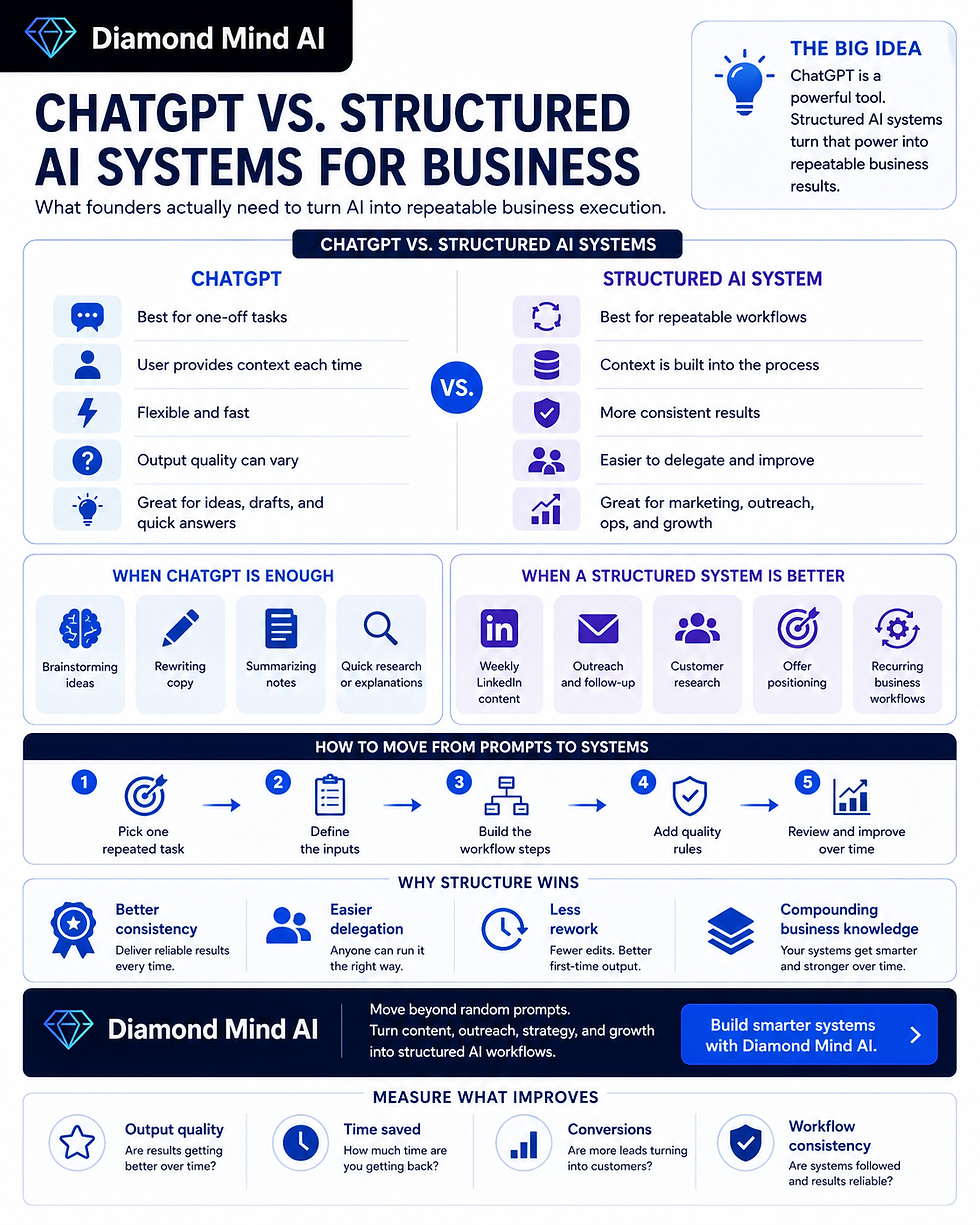
An AI business system is a repeatable process that combines business context, prompts, workflow logic, templates, and quality rules to produce a specific business outcome.
Here is a simple example.
A founder wants to create LinkedIn content every week.
Without a system, they ask:
“Write me a LinkedIn post about my business.”
With an AI business system, the workflow is different:
Define the audience.
Clarify the offer.
Choose the content objective.
Select the topic angle.
Pull from approved positioning.
Draft the post.
Improve the hook.
Review against brand rules.
Add the CTA.
Track performance.
The AI is still helping create the output.
But now it is operating inside a process.
That is what makes it repeatable.
The goal is not to make the founder less creative. The goal is to remove unnecessary friction from work that needs to happen consistently.
AI Tools vs. AI Business Systems
A tool helps you perform a task.
A system helps you produce a result repeatedly.
That distinction matters.
ChatGPT is a tool.
Claude is a tool.
Notion AI is a tool.
Zapier is a tool.
Canva is a tool.
But a business system defines how those tools work together to produce a result.
For example, “AI content creation” is not a full system.
A real AI content system includes audience definition, positioning, topic selection, content generation, editing rules, publishing workflow, and performance review.
The tool creates the asset.
The system creates consistency.
This is where many businesses get stuck.
They keep adding AI tools, but their actual process does not improve.
They become faster at producing disconnected work.
That is not the same as building leverage.
Why AI Business Systems Matter Now
The first wave of AI adoption was about access.
Who could use ChatGPT?
Who could create content faster?
Who could automate small tasks?
That phase is already crowded.
The next phase is about structure.
Businesses that win with AI will not be the ones with the most prompts. They will be the ones with the clearest systems.
This matters because most business work is connected.
Marketing connects to sales.
Sales connects to CRM.
CRM connects to follow-up.
Follow-up connects to revenue.
Revenue connects to strategy.
If AI only helps with isolated tasks, it creates speed without alignment.
An AI business system connects the pieces.
That is especially important for founders, consultants, marketers, and small teams because they do not have unlimited staff. They need workflows that help them execute consistently without adding unnecessary headcount.
The Five Parts of an AI Business System
A strong AI business system has five parts.
1. Business context
AI needs context to produce useful work.
That includes:
who the business serves
what the business sells
what problem it solves
how the business is positioned
what tone it uses
what outcome matters
Without context, AI guesses.
Sometimes it guesses well.
Often, it creates generic output that sounds polished but does not fit the business.
For a founder, this is dangerous because polished generic work can feel productive while doing very little to create market advantage.
A good AI business system starts by capturing the business context before generating output.
2. Workflow logic
A workflow is the sequence of steps required to reach an outcome.
For example, a content workflow may include:
selecting the audience
choosing a theme
generating ideas
drafting the post
improving the hook
adding a CTA
reviewing for brand fit
scheduling the content
measuring performance
The sequence matters.
A good system does not just ask, “What do you want to write?”
It guides the user through the right thinking process before producing the output.
That is the difference between a prompt and a workflow.
Templates turn repeated work into repeatable execution.
A business may need templates for:
LinkedIn posts
cold emails
landing pages
customer research
sales scripts
investor updates
marketing plans
hiring scorecards
operations checklists
The point is not to make everything robotic.
The point is to stop rebuilding from scratch.
A strong template gives structure while still allowing customization.
4. Quality rules
AI output needs standards.
Without quality rules, AI creates content that may sound good but fail strategically.
Quality rules can include:
tone guidelines
banned phrases
formatting preferences
audience rules
evidence requirements
brand positioning
CTA structure
review checklist
This is one of the biggest differences between casual AI use and business AI use.
Casual AI use accepts anything that sounds decent.
Business AI use needs outputs that are accurate, on-brand, useful, and tied to a specific outcome.
5. Feedback and improvement
A real system improves.
If a LinkedIn post performs well, the system should learn from it.
If a cold email gets replies, the system should capture the pattern.
If a landing page converts poorly, the system should identify what needs to change.
This is where most AI users fall short.
They use AI to create more output, but they do not use AI to improve the system behind the output.
The best AI business systems do both.
They help produce the work, and they help the business improve how the work gets done.
Examples of AI Business Systems
Here are practical examples of AI business systems a founder or small team can use.
AI content system
An AI content system helps produce consistent content across LinkedIn, blogs, emails, and landing pages.
It may include audience research, topic generation, content calendars, post templates, brand voice rules, publishing schedules, and performance reviews.
This is useful for founders, consultants, marketers, and creators who need consistent visibility.
AI outreach system
An AI outreach system helps identify prospects, segment audiences, write messages, and follow up.
It may include target audience definition, lead research, message templates, personalization rules, follow-up timing, reply tracking, and referral prompts.
This is useful for service businesses, agencies, B2B startups, and consultants.
AI strategy system
An AI strategy system helps clarify positioning, offers, pricing, competitive advantage, and execution priorities.
It may include audience analysis, offer refinement, competitor review, SWOT analysis, strategic recommendations, and execution roadmaps.
This is useful for founders, operators, executives, and consultants.
AI operations system
An AI operations system helps document repeatable processes and improve internal execution.
It may include SOP creation, meeting summaries, decision logs, project checklists, task routing, and accountability tracking.
This is useful for small teams that need better execution without adding management complexity.
AI research system
An AI research system helps gather, structure, and summarize information for better decisions.
It may include market research, competitor review, source gathering, trend analysis, customer insight extraction, and executive summaries.
This is useful for consultants, analysts, marketers, and founders making strategic decisions.
Why Prompt Libraries Are Not Enough
Prompt libraries are helpful.
But they are not enough.
A prompt library gives you inputs.
A business system gives you a process.
Prompt libraries assume the user already knows what to ask.
AI business systems guide the user toward better thinking.
That is the stronger value proposition.
For founders and marketers, the real problem is not just writing faster. The real problem is making better decisions, staying consistent, and executing without starting over every day.
A prompt can help you once.
A system can help you repeatedly.
Where Diamond Mind AI Fits
Diamond Mind AI is built around a simple belief:
AI becomes more valuable when it is structured.
The platform is not meant to be another generic chatbot or random prompt library.
It is designed to help founders, marketers, and operators turn scattered ideas into repeatable business workflows.
Instead of forcing users to figure out every prompt from scratch, Diamond Mind AI gives them structured systems for areas like:
marketing
content
outreach
strategy
operations
business planning
growth workflows
The goal is not to replace human judgment.
The goal is to improve the thinking process before the output is created.
That is why structured AI systems are more powerful than random prompting.
Random prompting gives you answers.
Structured systems create repeatable execution.
How to Build Your First AI Business System
Start small.
Do not try to automate your entire business in one week.
Pick one repeated workflow that already matters.
Good starting points include:
weekly LinkedIn content
prospect outreach
sales follow-up
blog planning
customer research
offer refinement
meeting summaries
proposal drafting
Then build the system in this order.
Step 1: Define the outcome
Be specific.
Weak outcome:
“Help with marketing.”
Stronger outcome:
“Create a weekly LinkedIn content plan for a founder selling AI business systems to entrepreneurs.”
Step 2: Define the user
Who is the workflow for?
A founder?
A marketer?
A sales admin?
A consultant?
A team member?
The system should match the person using it.
Step 3: Define the inputs
What information does the system need?
Useful inputs may include audience, offer, tone, examples, company context, goals, constraints, and data sources.
Step 4: Define the process
What are the steps?
For a content workflow, the process may be:
Choose objective.
Select audience.
Generate topic angles.
Pick one angle.
Draft the post.
Improve the hook.
Add CTA.
Review for brand fit.
Step 5: Define the output
What should the system produce?
Examples include one LinkedIn post, five topic ideas, one content calendar, one email sequence, one strategy memo, or one SOP.
Step 6: Test and improve
Run the workflow.
Review the output.
Adjust the inputs.
Improve the template.
Repeat.
That is how a basic AI workflow becomes a business system.
Common Mistakes to Avoid
Mistake 1: Starting with tools instead of outcomes
Do not ask, “What AI tool should I use?”
Ask, “What business result do I need to produce repeatedly?”
The tool comes after the system.
Mistake 2: Automating a broken process
If the process is unclear manually, AI will not fix it.
It will just make the confusion faster.
Clarify the workflow before automating it.
Mistake 3: Using generic prompts for strategic work
Generic prompts create generic output.
Strategic work requires business context, positioning, constraints, and clear success criteria.
Mistake 4: Ignoring quality control
AI can produce polished mistakes.
Every AI business system should include review rules.
Mistake 5: Treating AI as a replacement for thinking
AI should improve thinking, not bypass it.
The best systems force clarity before generation.
That is where the leverage comes from.
Final Thought
The businesses that win with AI will not be the ones collecting the most tools.
They will be the ones turning their best thinking into repeatable systems.
That is what an AI business system does.
It captures context.
It organizes workflow.
It improves output.
It reduces rework.
It makes execution more consistent.
And most importantly, it helps founders and teams move from scattered prompting to structured growth.
AI is no longer just about getting answers faster.
It is about building systems that make the business smarter every time they are used.
Ready to move beyond random prompting? Start with Diamond Mind AI and turn your business workflows into structured AI systems.


Comments